
 317-488-5500


Known as the “Crossroads of America,” Indiana sees an immense volume of commercial truck traffic every single day. Major interstate corridors – including I-65, I-70, I-80, I-94, and I-69 – are packed with 18-wheelers, tractor-trailers, and double semi-trucks hauling freight across the country.
While commercial shipping drives the economy, it also creates severe hazards for passenger vehicle drivers. Due to the massive size and weight disparity between an 80,000-pound semi-truck and a standard car, collisions are rarely minor.
If you or a loved one has been involved in a commercial vehicle collision in Indiana, taking the right steps immediately after the crash is crucial to protecting your health and your legal rights. This comprehensive guide outlines what you must do after a truck accident, how Indiana laws affect your case, and how to recover the financial compensation you deserve with the help of an experienced Indiana truck accident lawyer.
Step 1: Immediate Actions at the Accident Scene
The moments immediately following a collision with an 18-wheeler are chaotic. If you are physically able, taking these steps at the scene will build a strong foundation for your injury claim:
1. Call 911 Immediately
Report the crash right away. Ask for emergency medical personnel and law enforcement. In Indiana, collisions involving commercial vehicles are investigated by the Indiana State Police or local county sheriff departments. An official police accident report (Officer’s Standard Crash Report) is vital evidence for your claim.
2. Seek Medical Attention
Never refuse medical evaluation at the scene. Shock and adrenaline can mask severe internal trauma, brain injuries, or spinal damage. Furthermore, insurance adjusters will look for gaps in treatment to argue that your injuries were not caused by the crash.
3. Identify the Truck and Driver
Commercial trucks are governed by strict Federal Motor Carrier Safety Administration regulations. Make sure to collect:
- The truck driver’s full name, phone number, and Commercial Driver’s License (CDL) number.
- The name and contact information of the trucking company (motor carrier).
- The USDOT Number and MC/MX Number displayed on the cab door.
- Insurance provider and policy number for the tractor and trailer.
- License plate numbers for both the cab and the trailer.
4. Document the Evidence
Use your smartphone to capture extensive photos and videos of the scene:
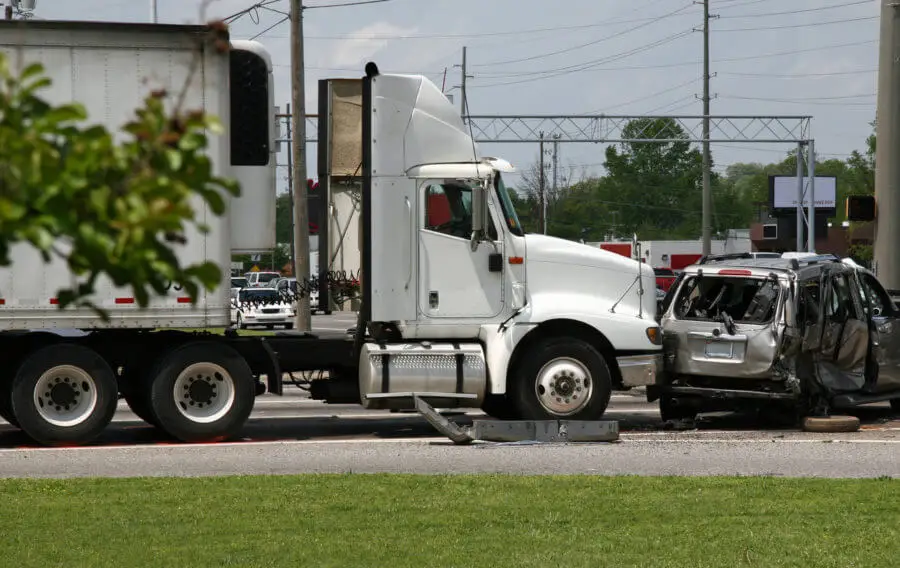
- Take photographs of all vehicles involved. Even if there is lots of damage on a semi truck after an accident, ensure you photograph the damage from multiple angles, including crushed metal, shattered glass, and broken axles.
- Capture skid marks, road debris, traffic signals, construction zones, and weather conditions.
- Photograph visible physical injuries (cuts, bruises, lacerations).
- Obtain contact details from any eyewitnesses who stopped to help.
Step 2: Understanding Severe Physical Trauma and Recovery Time
Truck crashes are far more destructive than standard passenger car accidents. The kinetic force involved often leads to catastrophic, multi-system physical damage.
Complex Crashes and Multi-Trailer Collisions
When tandem trailers or multi-rigs are involved, the risk of catastrophic injury increases exponentially. Severe injuries to body after double semi truck accident scenarios often include:
- Traumatic Brain Injuries and severe concussions;
- Spinal cord injuries leading to partial or total paralysis;
- Multiple bone fractures requiring surgical fixation;
- Internal organ damage and severe internal bleeding;
- Amputations or crush injuries.
Long-Term Impact and Lost Wages
Recovery from a commercial truck collision is rarely a matter of weeks. Many victims find themselves unable to work or perform daily tasks for extended periods. If you are out 9 months after semi truck accident injuries require ongoing surgeries, physical therapy, and specialized care, your financial strain can become overwhelming.
A personal injury claim allows you to recover not just your past medical bills, but also your future medical expenses and all lost earnings during your long recovery period.
Step 3: Crucial Indiana Truck Accident Laws You Must Know
Indiana personal injury law contains specific statutes that directly impact your ability to recover compensation after a truck crash.
1. Statute of Limitations in Indiana
Under Indiana Code § 34-11-2-4, you generally have two (2) years from the date of the accident to file a personal injury lawsuit against the at-fault parties.
Important Exception: If a government entity was involved (such as an Indiana Department of Transportation road maintenance truck), you must file a formal Tort Claim Notice within 180 days (for political subdivisions) or 270 days (for state agencies). Missing these deadlines permanently bars your claim.
2. Indiana’s Modified Comparative Fault Rule (51% Bar Rule)
Indiana operates under a modified comparative fault system (Indiana Code § 34-51-2-6). Under this rule, your compensation is reduced by your percentage of fault – and if you are found to be 51% or more at fault, you cannot recover any compensation at all.
What happens after a 50/50 fault accident between a semi truck and car?
If an investigation determines that a crash between a semi-truck and a car was a 50/50 fault accident, the driver of the car is still eligible to recover damages under Indiana law. Because you are not more than 50% at fault (you do not hit the 51% bar), you can collect compensation. However, your total monetary award will be reduced by your 50% share of fault.
For example, if your total damages (medical bills, lost wages, pain and suffering) equal $500,000 in a 50/50 fault scenario, you would be entitled to receive $250,000 (50% of the total). Because insurance companies aggressively push to assign 51% fault to car drivers to avoid paying anything, having a skilled Indiana truck accident lawyer to disprove false fault accusations is critical.
Step 4: Trucking Industry Dynamics & Insurance Company Tactics
Commercial trucking insurers are backed by massive corporate resources. Their primary goal after a major wreck is liability containment.
High Stakes for Trucking Companies
A major crash has devastating financial consequences for a motor carrier. If a driver causes a catastrophic wreck, or if a fleet exhibits a pattern of safety violations, a semi truck insurance won’t renew coverage after accident occurrences. Losing insurance coverage effectively shuts down a trucking company’s business.
Because their commercial policy and business survival are on the line, trucking companies and their insurers send rapid-response teams – investigators, risk managers, and defense attorneys – to crash sites within hours. Their job is to find ways to shift blame onto you.
What NOT To Do When Dealing with Truck Insurers:
- Do NOT give a recorded statement: Insurance adjusters use leading questions to trick you into admitting partial fault.
- Do NOT sign medical releases: They will dig through your entire medical history to claim your injuries were “pre-existing.”
- Do NOT accept a quick settlement: Early settlement offers are lowball amounts designed to close your case before you understand the full extent of your long-term medical needs.
Step 5: Determining Liability and Preserving Essential Evidence
Unlike standard car accidents where liability is usually limited to one driver, commercial truck accidents often involve multiple liable parties:
- The Truck Driver: For fatigued driving, speeding, distracted driving, or driving under the influence.
- The Motor Carrier/Trucking Company: For negligent hiring, inadequate training, or forcing drivers to violate FMCSA Hours of Service rules.
- Cargo Loading Companies: For improperly securing or overloading cargo, causing shifting loads and jackknife accidents.
- Maintenance Vendors: For failing to properly inspect or repair vital components like brakes, steering, and tires.
Preserving “Black Box” (EDR/ECM) Data
Commercial trucks contain an Event Data Recorder or Engine Control Module – commonly called the truck’s “black box.” This device logs critical data prior to impact, including:
- Vehicle speed before impact;
- Brake application and throttle position;
- Steering angles;
- Hours driven without mandatory rest breaks (via Electronic Logging Devices – ELD).
This electronic data can be overwritten or destroyed after a few weeks. An experienced Indiana truck accident attorney will immediately issue a legal Spoliation Letter to the trucking company, legally compelling them to preserve all electronic data, dashcam footage, maintenance logs, and drug testing results.
Step 6: Damages You Can Recover in an Indiana Truck Accident Claim
If you were injured in an Indiana semi-truck accident due to someone else’s negligence, you are entitled to pursue compensation for all losses, including:
Economic Damages (Tangible Losses)
- All current and future medical bills (hospitalization, surgery, medications, rehabilitation);
- Past lost wages and future loss of earning capacity;
- Property damage (repair or full fair market replacement value of your vehicle);
- Out-of-pocket expenses (transportation to medical visits, home modifications).
Non-Economic Damages (Intangible Losses)
- Physical pain and suffering;
- Emotional distress and trauma;
- Permanent disability, disfigurement, or scarring;
- Loss of enjoyment of life and loss of consortium.
Why You Need an Experienced Indiana Truck Accident Attorney
Navigating federal trucking regulations, complex insurance policies, and Indiana’s modified comparative fault laws while recovering from severe injuries is nearly impossible to do alone.
An experienced Indiana personal injury attorney will:
- Conduct a thorough, independent investigation of the crash scene;
- Issue spoliation demands to freeze all electronic truck data;
- Consult with accident reconstructionists, medical experts, and economic planners;
- Calculate the true value of your long-term claim;
- Fight aggressive insurance tactics and take your case to trial if a fair settlement is not offered.
Most personal injury attorneys handle truck accident cases on a contingency fee basis. This means you pay zero upfront costs or legal fees unless your lawyer successfully recovers money for you through a settlement or court verdict.
Contact an Indiana Truck Accident Lawyer Today
If you have been hurt in a collision with a commercial semi-truck anywhere in Indiana, do not wait. Time is critical for preserving evidence and protecting your rights. Contact a dedicated Indiana truck accident lawyer today for a free, no-obligation case evaluation.
Call 317-488-5500 or complete a Free Case Evaluation form
