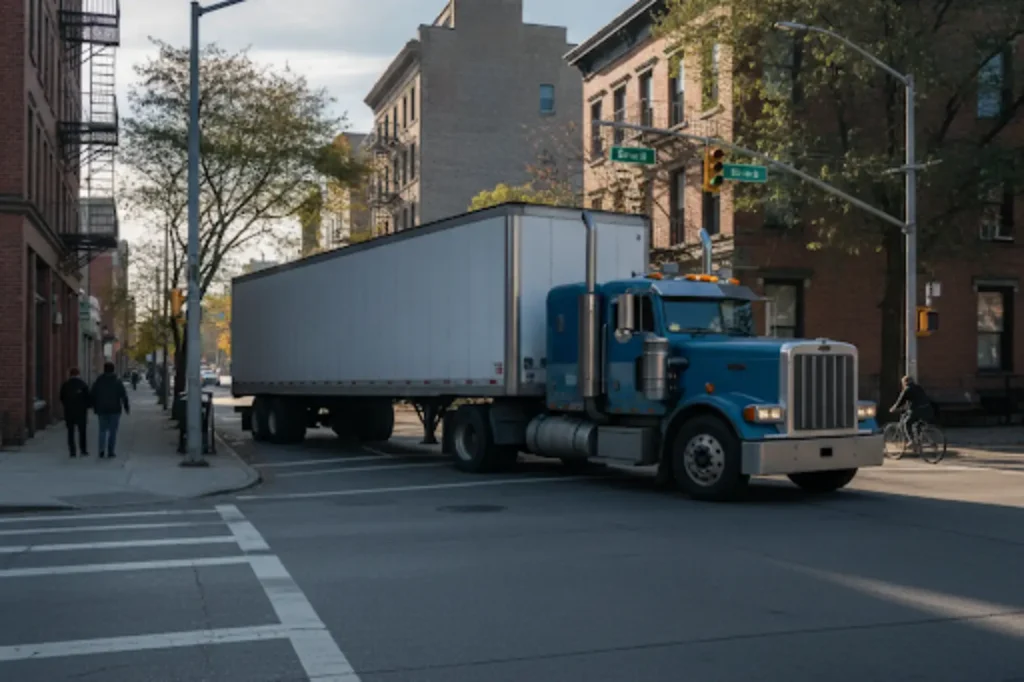
Truck drivers are trained on this hazard and equipped to manage it, which is why a wide turn crash is usually a failure of a duty rather than an unavoidable geometry problem. If you want to know how that duty applies to what happened to you, a free consultation costs nothing and there is no fee unless we win.

How Our Indianapolis Wide Turn Accident Lawyers Build Your Case

A wide turn case is a geometry problem and an evidence race, and both favor whoever moves first. This is the sequence our team runs in the days after the crash. Personal injury is all we do, and you owe no fee unless we win.

  • Establish the truck’s swing path with scene evidence. Tire marks, curb scuffs, and the final rest position show how far left the tractor moved before the turn and how much room the trailer took on the way around.
  • Recover video before it overwrites. Downtown businesses, apartment entrances, and transit vehicles record the intersections where these crashes happen, and most systems retain footage for only days.
  • Pull the mirror and equipment record. 49 CFR 393.80 requires every truck and truck tractor to carry two rear-vision mirrors, one on each side, positioned to show the driver the highway to the rear along both sides of the vehicle. A missing, misadjusted, or damaged mirror converts “I never saw them” from a defense into the breach itself.
  • Document signal and lane position. Whether the driver signaled, how long before the turn, and whether the tractor’s left drift misled traffic behind it are all answerable from video and witness accounts.
  • Identify the trailer owner separately. The tractor, the trailer, and the load frequently belong to different companies, and a trailer with an equipment defect brings a different insurer into the case.
  • Match the injuries to a sweeping impact. Being caught by a turning trailer produces crush and drag injuries instead of the deceleration pattern of a frontal crash, and the medical proof has to reflect that.

Decades of Indiana trial experience have shown this firm that these cases are won on video and geometry. Tell us the corner and the date, and we can say which cameras are likely still holding footage.

Speak with a personal injury lawyer today. Call: 317-488-5500

How a Wide Right Turn Traps the Space Beside a Truck

The squeeze play unfolds in about five seconds, and each stage of it corresponds to a piece of evidence we look for afterward. Walking through the sequence is how we show an adjuster, or a jury, that the crash was a preventable failure rather than bad luck. That analysis starts with a free case review.

  1. The setup. To clear the corner, the driver moves the tractor left, sometimes into the adjacent lane. From behind, this reads as a lane change or a left turn.
  2. The invitation. A gap opens along the truck’s right side. On streets like College Avenue and through Fountain Square, that gap sits exactly where a bike lane or a right-turn lane runs.
  3. The blind spot. The right side carries the largest no-visibility zone on a commercial vehicle. A car or cyclist alongside the trailer can be entirely out of view.
  4. The closure. As the tractor completes the turn, the trailer tracks inside the tractor’s path and sweeps through the gap. Anything in it is struck laterally or pulled under.
  5. The aftermath. Because the trailer is moving sideways relative to the victim, people are frequently dragged or pinned rather than pushed clear, which is why these crashes produce injuries far out of proportion to the truck’s speed.

Cyclists and people on foot bear the worst of this pattern, and our team handles bicycle accident and pedestrian accident claims arising from turning trucks throughout Marion County.

Personal Injury 317-488-5500

Indiana Law and Fault in a Wide Turn Crash

Indiana does not give a commercial driver a free pass because a turn is difficult. A driver making a right turn must complete it as safely as the vehicle allows, which includes checking mirrors before and during the swing, signaling early enough for traffic behind to react, and refusing to start the turn when the right side is occupied. Where a driver began the maneuver without confirming the space was clear, the wide turn is not an explanation, it is the negligence.

Fault also reaches past the person behind the wheel. A carrier that failed to train drivers on right-turn procedure, dispatched an oversized combination onto streets it could not turn on, or ignored a damaged mirror shares responsibility. Sorting out every liable party is usually the first analytical step, because it determines which insurance policies are available.

Timing matters as much as liability. Indiana gives most injury claimants two years from the day a claim accrues, under IC 34-11-2-4, and the video that proves a wide turn case disappears long before that deadline arrives. A free consultation early is the practical way to protect both.

Click to contact us today

Common Injuries in Indianapolis Wide Turn Accidents

A sweeping trailer strikes at door height or drags a person along the pavement, and the injury pattern reflects that:

  • Crush injuries to the legs and pelvis. From being pinned between the trailer and a curb, barrier, or parked vehicle.
  • Traumatic brain injury. Common where a cyclist or pedestrian is knocked down and strikes the roadway.
  • Paralysis. Spinal damage from lateral loading or from being run over by trailer wheels.
  • Degloving and road rash. Severe soft tissue loss from being dragged, frequently requiring grafting.
  • Amputation. Where a limb is caught under a wheel or between the trailer and a fixed object.
  • Rib, sternum, and internal injuries. From side impact against a vehicle door with little structure behind it.
  • Underride injuries. Where a vehicle is pushed beneath the trailer as it comes around.

Getting these documented thoroughly at the first hospital visit is what prevents a carrier from later describing a life-changing crash as a low-speed contact.

What Compensation Can You Recover After a Wide Turn Accident in Indianapolis

Because a turning truck is usually moving slowly, carriers open these files expecting a small payout, and the injuries almost never match that expectation. The damages picture has to be built from the actual medical course, not the speed on the police report.

  • Economic damages. Ambulance and trauma care, surgery, skin grafting, orthopedic hardware, rehabilitation, and the future procedures a crush injury tends to require, plus lost wages and reduced earning capacity.
  • Non-Economic damages. Physical pain, permanent scarring and disfigurement, and the loss of activities such as cycling or walking a normal commute that a person may not recover.
  • Future medical and care costs. Projected by treating physicians and, where an injury is permanent, by a life care planner rather than estimated from the bills already received.
  • Loss of household services. The daily work you can no longer do while recovering or permanently.

Any award is reduced by whatever share of fault is assigned to you, and a claimant found 51 percent or more responsible recovers nothing under IC 34-51-2-6. Christie Bell & Marshall documents both halves, because in a wide turn case the fault argument and the damages argument are the same fight.

Do You Have an Indianapolis Wide Turn Claim?

Kevin P. Farrell handles motor vehicle and vulnerable road user claims at Christie Bell & Marshall, including crashes involving cyclists and pedestrians struck by turning commercial vehicles. Here is his perspective on wide turn claims in Indianapolis.

“The driver’s own mirrors are usually the whole case. Federal rules require them on both sides for exactly this maneuver, so when a driver says the cyclist came out of nowhere, the real question is what the right mirror was showing and whether anyone looked at it.”

Do You Qualify?

A wide turn claim is worth reviewing if:

  • A truck swung left before turning right and struck you as the trailer came around
  • You were riding, walking, or driving in a lane, bike lane, or shoulder to the truck’s right
  • The driver told police they did not see you, or the truck left the scene unaware of the contact

What Cases Like Yours Have Recovered

This firm obtained $2,200,000 for a 24-year-old cyclist riding with a charity group who was struck by a pickup truck, and $750,000 for a passenger in an Uber vehicle struck when another driver ran a red light. Further matters appear on our case results page. Past results cannot guarantee what any individual case will produce, because every claim turns on its own facts.

A carrier’s assurance that the turn was unavoidable is a conclusion, not a finding, and geometry is testable.

Contact an Indianapolis Wide Turn Accident Lawyer

Intersection video is the most valuable evidence in these claims and the fastest to disappear. Sending preservation requests to the businesses and agencies around the corner where you were hurt is work that has to happen in days, not months.

Personal injury is all we do. Reach Christie Bell & Marshall through our contact page, and we will tell you plainly whether the evidence this kind of claim needs still exists.

FAQs About Indianapolis Wide Turn Accidents

What is a right turn squeeze in trucking?

It is the gap that opens along a truck’s right side when the driver swings left to make a right turn. Vehicles and cyclists move into that space, and the trailer closes it as it tracks around the corner. Truck drivers are trained to prevent it by blocking the lane rather than leaving room beside them.

Are trucks allowed to make wide turns?

Yes. A long combination vehicle physically cannot turn tightly, so swinging wide is lawful and expected. What is not permitted is starting or continuing that maneuver when the space beside the truck is occupied. The legal question is never whether the turn was wide, it is whether the driver checked before closing the gap.

The driver says they never saw me. Does that help my claim?

Usually it helps you. Federal equipment rules require mirrors covering both sides of the vehicle precisely because of this blind spot, so a driver who did not see a cyclist or car alongside the trailer is describing a failure to look rather than an excuse.

What if I was in the bike lane when the truck turned?

A rider lawfully in a bike lane has the right to be there, and a turning driver must yield before crossing it. Fault arguments in these cases usually center on whether the rider was visible and for how long, which is why intersection video matters so much.

Can I still recover if I was partly to blame?

Possibly. Indiana reduces an award in proportion to your share of fault and bars recovery entirely once that share reaches 51 percent, so how comparative fault works is worth knowing early. An insurer’s assertion that you rode into a blind spot is a negotiating position, not a determination, and it deserves an answer built from the scene evidence.