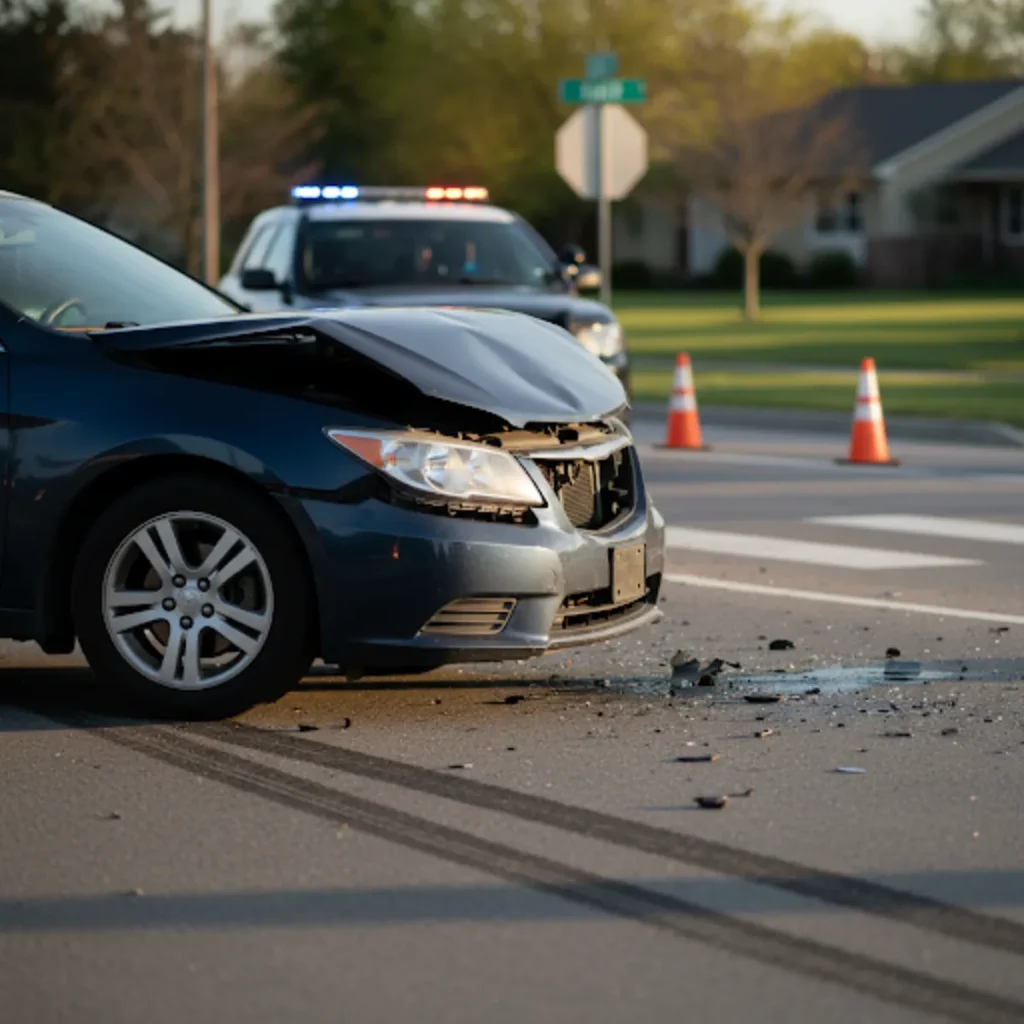
How Our Bloomington Intersection Accident Lawyers Build Your Case

Federal Highway Administration analysis attributes roughly half of all serious crashes nationwide to events at or near intersections. In Bloomington, right-of-way is rarely settled by the police report alone.

The at-fault driver almost always claims the light was yellow, that you turned in front of them, or that they had already cleared the gap. Adjusters know signal-phase logs and storefront surveillance video purge on tight retention schedules, so their week-one strategy is to delay until the proof is gone. Our team builds the proof they cannot argue with:

  • Subpoena the signal-phase log from the controller cabinet. The City of Bloomington and INDOT controllers keep timestamped logs of every phase change. Pulled within the retention window, that log nails down which direction had green at the second of impact.
  • Pull surveillance video from every business inside a 200-foot radius. Restaurants, gas stations, banks, and parking garages along the corridor often capture the approach, the impact, and the rest position. Most overwrite their drives every 14 to 30 days.
  • Download the event data recorder from each vehicle. EDR data shows pre-impact speed, brake application, throttle, and steering angle for both drivers, which usually settles whether anyone tried to stop.
  • Identify and preserve dashcam video from rideshare and delivery drivers. Bloomington’s Uber, Lyft, DoorDash, and IU shuttle traffic at major intersections means a third-party recording often exists if you find it before the driver wipes the camera.
  • Run a sight-distance and signal-timing study with a traffic engineer. When the city’s signal phase is part of the dispute, an engineer reconstructs whether the cycle was set correctly and whether either driver had a reasonable opportunity to perceive and react.
  • Pull the cited driver’s prior moving-violation history. A pattern of red-light running or failure-to-yield citations can support a punitive damages theory or admissible habit evidence.

Christie Bell & Marshall brings four decades of Indiana trial experience to every intersection file we open, and our case results show what that evidence-first approach has recovered for injured Hoosiers. We put the evidence work in motion the same week you call so the proof is ours, not the carrier’s.

Speak with a personal injury lawyer today. Call: 317-488-5500

Indiana Law and Right-of-Way at Bloomington Intersections

The statute the defense argues from decides whether negligence per se attaches, and that changes with the corner: a signal violation runs on one statute, a stop-sign violation on another, a rural crossroads on a third. Indiana’s $25,000 bodily injury minimum is often gone on the trauma-bay invoice alone in a serious side-impact, so the work of adding defendants and policies starts with picking the right statutory frame on day one.

Right-of-Way and Stop-Control Duties

Indiana Code 9-21-8-32 governs stop-sign duties, and IC 9-21-8-29 governs traffic-signal obedience. A driver who enters an intersection against a red light or fails to stop and yield at a stop sign has breached a statutory duty, which in Indiana civil law is negligence per se.

Modified Comparative Fault

IC 34-51-2 lets you recover when you are 50 percent or less at fault, with your share reducing the recovery dollar for dollar. In intersection cases, defense lawyers often try to assign you 20 to 30 percent for “failing to see what was there to be seen.” Indiana’s comparative fault rules reward an investigation that documents your sight lines, your speed, and the time available to react.

Statute of Limitations

Two years from the date of the crash to file suit under IC 34-11-2-4. When a public entity is on the hook for a malfunctioning signal or a sight-obstruction, the Indiana Tort Claims Act adds a 180-day notice deadline for city and county defendants and 270 days for the state. Treat both as hard stops.

Know More About Your Rights in a Free Consultation

Christie Bell & Marshall builds every intersection case on this statutory framework before the first demand letter goes out, including any commercial driver, employer, or governmental liability the facts open up.

We can explain how these laws apply to your case and build your claim around the full statutory value available, not just the at-fault driver’s bodily injury minimum, because that minimum almost never matches the medical reality of a serious side-impact crash.

Complete a Free Case Evaluation form now

Common Injuries in Bloomington Intersection Crashes

The Insurance Institute for Highway Safety has tracked side-impact protection for decades and consistently shows that even well-rated vehicles transmit substantially more occupant force in T-bones than in equivalent-energy frontal crashes. On Bloomington intersection files, the injuries we most often work to document include:

  • Side-impact head trauma, including traumatic brain injury from contact with the door frame or B-pillar.
  • Cervical spine and shoulder injuries from lateral whiplash motion.
  • Pelvic and hip fractures from intrusion of the door into the occupant space.
  • Rib and lung injuries including pneumothorax from chest contact with the side airbag housing or seatbelt loading.
  • Wrist, hand, and forearm fractures from bracing against the steering wheel or window frame.
  • Soft-tissue back injury and herniated discs that develop weeks after the crash.
  • Pedestrian and cyclist crush injuries when the at-fault driver runs the light into a person crossing legally.

Christie Bell & Marshall coordinates with treating physicians at IU Health Bloomington from the first week so the medical record matches the severity, and we retain outside specialists when the chart needs more than primary care can provide.

Click to contact us today

What Compensation Can You Recover After a Bloomington Intersection Accident

Adjusters open negotiations on intersection files anchored to the acute hospital invoice, not because that number reflects the case’s value but because it is the smallest defensible figure they can put on paper. Getting to a number that reflects the case means quantifying years of orthopedic surgery, pain management, neurology, and vocational impact, alongside the non-economic harm Indiana law allows. Each piece needs documentation the carrier cannot dismiss as speculative.

On a typical Bloomington intersection file, we pursue:

  • Emergency care, surgery, and hospitalization at IU Health Bloomington or Monroe Hospital, plus follow-up imaging and specialist visits.
  • Future medical care for orthopedic surgery, pain management, neurology, and physical therapy, often projected over decades for younger plaintiffs.
  • Past and future lost wages during recovery, plus diminished earning capacity when an orthopedic or neurological injury changes the work you are able to perform.
  • Pain and suffering for physical pain, emotional distress, and the disruption the crash caused in your daily life.
  • Loss of enjoyment of life for hobbies, family activities, and physical capabilities you can no longer participate in.
  • Loss of consortium for a spouse whose relationship has been altered by the injury.
  • Property damage for the vehicle, plus rental costs and personal property in the cabin.
  • Punitive damages when the at-fault driver was impaired, racing, or showed conscious disregard, with the cap set by IC 34-51-3.

Our team works with economic experts, vocational rehab specialists, and life-care planners on every intersection file where the medical exposure is meaningful, because demanding a future-loss number without that workup is the fastest way to leave money on the table.

Decades of Indiana trial experience taught us how Marion and Monroe County juries actually value pain and suffering, lost capacity, and disfigurement, and how to push past the carrier’s first offer to a number that reflects that reality.

Do You Have a Bloomington Intersection Accident Claim?

Kevin P. Farrell handles car and motorcycle injury claims across Indiana, and most of his intersection files come down to a single question: who actually had the right of way. Here is how he approaches proving it.

An intersection case is won on the physical record, not on who sounds more convincing in a recorded statement. The other driver almost always insists the light was green for them, so I go straight to the proof that does not change its story: the signal-phase log from the controller cabinet, the storefront camera that caught the approach, and the event data recorder that shows who was braking and who was not. Once those line up, the adjuster’s version stops mattering. What you do in the first days makes that work possible.

Get the name and number of every witness before they leave the scene, photograph the signal heads and the final rest positions if it is safe to, and call a lawyer the same week so the video gets preserved before it overwrites. A police report that does not cite the other driver is not the end of your claim either, because a civil case turns on the weight of the evidence, not on whether an officer wrote a ticket.

What Cases Like Yours Have Recovered

Recent Christie Bell & Marshall recoveries on intersection right-of-way and multi-occupant crash files include:

  • A $750,000 recovery for an Uber passenger struck when the other driver ran a red light, built on signal-phase and witness evidence.
  • A $2,400,000 recovery for a mother and her two daughters injured in a single crash, the kind of multi-occupant outcome that often follows a Bloomington intersection T-bone where children or other family members are in the cabin.

We encourage you to get in touch about an intersection crash like yours, and we will give you a candid assessment of the right-of-way proof and what your file is worth at the first meeting.

Contact a Bloomington Intersection Accident Lawyer at Christie Bell & Marshall

Speed of action matters on an intersection file in a way that it does not on most other claim types, and Christie Bell & Marshall’s evidence-first approach is built around that reality.

We get to work while you get to heal. Contact Christie Bell & Marshall to schedule your free initial consultation with an intersection accident lawyer.

FAQs About Bloomington Intersection Accidents

Who is liable when a turning driver runs a flashing yellow arrow at College Avenue?

A flashing yellow arrow lets a driver turn only after yielding to oncoming traffic and any pedestrian, so a driver who turns into your path has breached that duty as a matter of law. We document the sight lines, the speed of oncoming traffic, and any distraction evidence that shows why the gap was misjudged.

What if I had the green light but the other driver insists I ran a red?

Signal-phase logs from the city or INDOT controller usually settle it, with storefront video, dashcam footage, and EDR data adding corroboration. The defense version rarely survives a signal log showing who actually had the green at impact.

Can I recover if the traffic signal was malfunctioning?

Yes, and the claim may reach a public entity like the City of Bloomington or INDOT when a signal was known to be malfunctioning or wrongly maintained. The Indiana Tort Claims Act notice deadlines apply, so the file has to move fast.

How long do I have to file an intersection accident claim in Indiana?

IC 34-11-2-4 gives you two years from the crash. If a public entity is involved, an Indiana Tort Claims Act notice is due within 180 days for a city or county defendant and 270 days for the state.

What if a turning driver hit me while I was going straight on the SR 45/46 Bypass?

A left-turning driver must yield to vehicles continuing straight under IC 9-21-8-31. At Bypass speeds the dispute often turns on whether you had time to react, which EDR data and reconstruction usually answer.