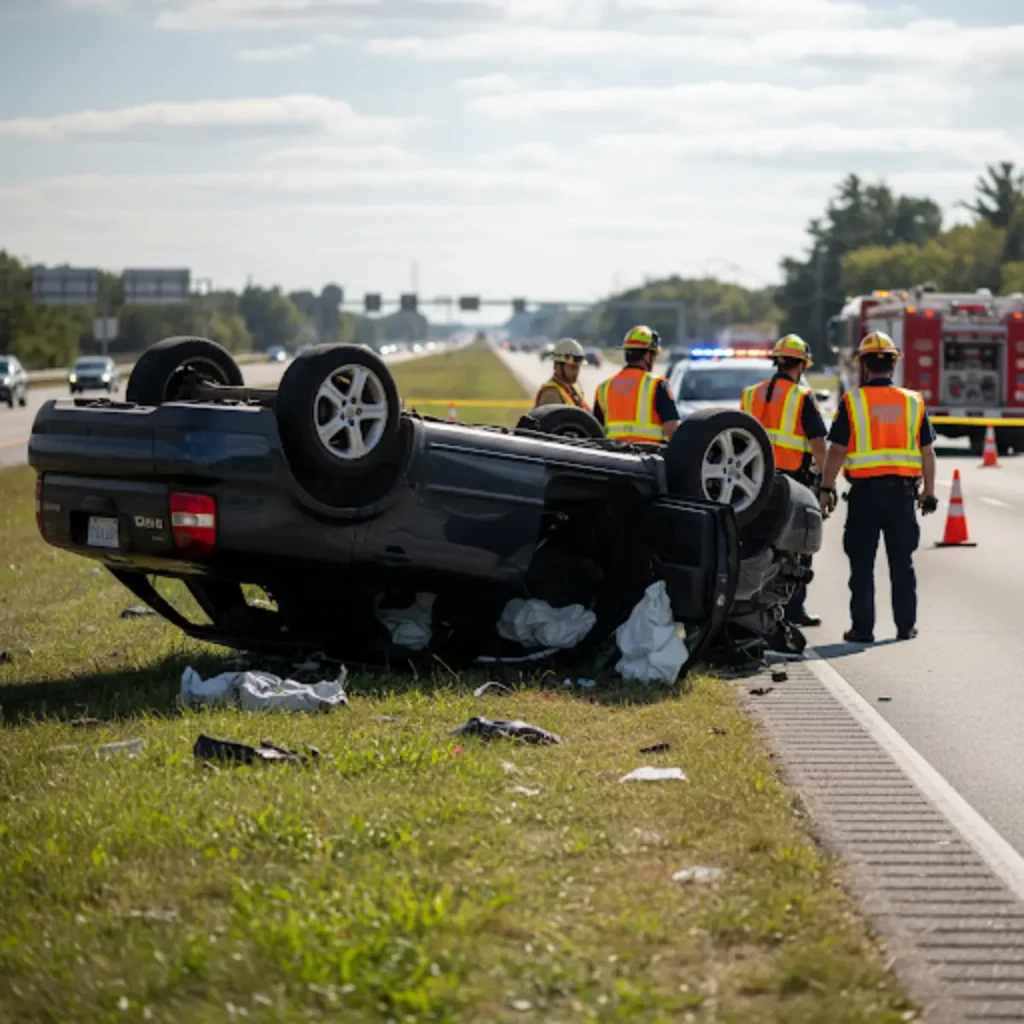
How Our Bloomington Rollover Accident Lawyers Build Your Case

Rollover crashes account for a small share of crashes but a disproportionate share of fatal occupant injuries according to long-running NHTSA data, particularly when the vehicle is a tall-profile SUV or pickup truck.

The defense almost always argues the driver’s conduct alone caused the rollover, because narrowing the case to the driver caps recovery at the auto policy. Christie Bell & Marshall pushes back by preserving the vehicle and developing roof-crush, occupant-retention, and stability proof for a product liability claim against the manufacturer. Our team builds a Bloomington rollover file with:

  • Secure the at-fault vehicle and the victim’s vehicle under a chain-of-custody agreement before salvage. A rollover vehicle released to auction within days loses every piece of physical evidence the engineering case depends on, and a preservation letter on day one is what keeps the file alive.
  • Retain a failure-analysis engineer to inspect the vehicle structure. The expert examines the roof crush ratio, the door-frame deformation, the seatbelt anchor geometry, and the airbag deployment pattern against the manufacturer’s design specs and the federal motor vehicle safety standards.
  • Download the event data recorder. EDR data captures pre-rollover speed, steering input, braking, and stability-control system status, which together establish whether the rollover was driver-induced, road-induced, or vehicle-induced.
  • Reconstruct the trip point and the rollover sequence. A reconstruction engineer documents whether the vehicle tripped on a curb, soft shoulder, or guardrail, and how many quarter-turns the rollover sequence produced before final rest.
  • Pull the vehicle’s recall and TSB history. Outstanding recalls, technical service bulletins, and known defect histories on a tall-profile SUV or pickup feed directly into the product liability theory.
  • Subpoena the at-fault driver’s training and employment records if commercial. Commercial driver training and supervision records, employer hours-of-service compliance, and dispatch records often open up an employer-liability layer beyond the driver’s personal coverage.

We move fast for one reason: a failure-analysis engineer has to read the roof crush, the belts, and the stability data off the actual wreck, and a salvage yard can crush that vehicle within two weeks. A manufacturer facing a documented product case negotiates very differently than a personal auto carrier. Our case results show what that engineering work has recovered on catastrophic crash files. Reach out to a Bloomington rollover accident lawyer at Christie Bell & Marshall for a free review while the vehicle is still in our hands.

Speak with a personal injury lawyer today. Call: 317-488-5500

Common Patterns of Rollover Crashes in Bloomington

The kind of rollover decides whether the case runs primarily against the at-fault driver, the vehicle manufacturer, the governmental entity responsible for the road, or some combination of all three. The Indiana Crash Facts report shows rollovers overrepresented in single-vehicle fatal crashes statewide, and Monroe County’s mix of curved rural state highways, suburban arterials, and interstate corridor produces several recognizable rollover scenarios:

  • Tripped rollovers on State Road 446 and State Road 46.
  • Untripped rollovers on I-69 and the SR 45/46 Bypass.
  • Commercial truck rollovers on outbound state highways.
  • Side-impact-induced rollovers at signalized intersections.
  • Roof-crush failures and ejection cases.

Knowing which rollover pattern fits the crash is what decides whether the file runs primarily on driver fault, product liability, roadway design, or all three. Your Bloomington rollover accident lawyer at Christie Bell & Marshall will match the investigation to the rollover mechanics themselves, because a tripped Monroe County curve case and an untripped SUV rollover demand entirely different engineering proof.

Complete a Free Case Evaluation form now

Indiana Law on Rollover Accident Liability

Rollover cases often reach further than a typical motor vehicle file because the catastrophic injury pattern justifies the expert and discovery investment a product liability claim requires. Identifying the driver, employer, manufacturer, and governmental defendants in week one is what can lift a single-defendant policy-limits case into a recovery large enough to cover the life-care plan.

Negligence and Modified Comparative Fault

The at-fault driver’s negligence runs under standard Indiana motor vehicle law, with IC 34-51-2 modified comparative fault letting you recover when you are 50 percent or less at fault, with your share reducing the recovery.

Indiana Product Liability Act

Indiana Code 34-20 governs product liability claims against vehicle manufacturers for design defects, manufacturing defects, and failure-to-warn theories. A rollover case alleging roof crush, seatbelt anchor failure, electronic stability control failure, or vehicle stability index inadequacy typically runs under this framework, with a 10-year statute of repose on the manufacturer’s exposure plus the standard two-year statute of limitations on the injury claim.

Statute of Limitations

The general personal injury filing deadline at IC 34-11-2-4 gives you two years from the date of the crash. Wrongful death claims under IC 34-23-1 carry a parallel two-year clock from the date of death.

Indiana Tort Claims Act

If a roadway design defect contributed to the rollover, the Indiana Tort Claims Act adds a 180-day notice deadline for city or county defendants and 270 days for the state. Roadway-induced rollovers frequently produce parallel claims against INDOT or Monroe County Highways alongside the driver and manufacturer claims.

Punitive Damages

IC 34-51-3 supports punitive damages where the conduct shows conscious disregard for safety. In product liability rollover cases, evidence that the manufacturer knew about a rollover defect and failed to recall, redesign, or warn frequently meets that standard.

Christie Bell & Marshall charts every Bloomington rollover file against that full framework on day one, because narrowing the defendant pool to the driver alone is the manufacturer’s standard defense strategy, and the engineering work that opens up the product liability layer has to start while the vehicle is still in our possession.

Click to contact us today

Common Injuries in Bloomington Rollover Crashes

Rollover crashes load forces on the body from multiple directions as the roof, doors, and side glass deform around the occupant, and the Insurance Institute for Highway Safety flags rollover as the most lethal occupant-protection scenario. On Bloomington rollover files, the trauma we most often work to document includes:

  • Traumatic brain injury from roof contact, side-window contact, or contact with deformed interior structures during the rollover sequence.
  • Cervical and thoracic spinal cord injuries from roof crush loading or from a partial ejection that drives the head into the door frame.
  • Severe burns and inhalation injury when a fuel tank ruptures during the rollover and ignites the wreck, particularly when occupants are trapped inside.
  • Multiple long-bone and pelvic fractures from intrusion of door frames, the roof, or footwell structure into the occupant space.
  • Crush asphyxia and chest injuries from prolonged loading when the vehicle comes to rest on its roof or side.
  • Internal organ damage including splenic and liver lacerations from belt loading during multiple impact phases.
  • Wrongful death and survivor PTSD in the worst-energy rollover crashes, particularly partial-ejection and roof-crush fatalities.

A rollover injury case turns on whether the harm came from the rollover dynamics or from a separable design or manufacturing defect, and the manufacturer’s defense team will work the dynamics framing in every deposition. We pair IU Health Bloomington trauma records with occupant-protection experts and a biomechanical engineer. They tie the specific injuries to the roof crush, seatbelt anchor failure, or stability defect rather than the rollover itself, which is what carries the product liability case through cross-examination.

What Compensation Can You Recover After a Bloomington Rollover Crash

The exposure on a serious rollover routinely runs into the millions once life-care planning, lost earning capacity, and decades of follow-up treatment are quantified, especially after a spinal cord injury or a roof-crush brain injury. Carriers and manufacturer defense teams anchor early settlement talks to acute medical billing and resist documenting future care, because that strategy keeps the offer low until trial pressure forces the number up. Indiana law lets you pursue the standard damages categories against each defendant with separate proof for each.

Economic Damages

A catastrophic rollover produces a damages model dominated by future skilled-nursing care, home modifications, and durable medical equipment that extends decades beyond the hospital stay. We build that future-care line with certified life-care planners, then pair it with lost earnings projections and vocational rehab tailored to the injury’s functional limits.

Non-Economic Damages

Pain and suffering, loss of enjoyment of life, disfigurement, and emotional distress are all recoverable under Indiana law, alongside loss of consortium for a spouse. A fatal rollover opens the additional Wrongful Death Act categories that frequently outweigh the survivor’s medical claim on a high-energy product liability file.

Punitive Damages in Product Liability Rollover Cases

Where the rollover involved a known manufacturer defect, evidence of internal documents showing the manufacturer knew about the rollover risk before the model went on sale frequently supports punitive damages under IC 34-51-3. The exposure in product liability rollover files often dwarfs the compensatory damages because the corporate defendant’s reserves and reputational concerns drive settlement dynamics very differently than a personal auto carrier.

Product liability rollover cases settle very differently from typical auto crash files, because the manufacturer defendant has corporate reserves, reputational concerns, and a national defense team that all push for earlier resolution once the engineering case is solid. Christie Bell & Marshall develops that engineering case in parallel with the driver-fault track, so the demand letter goes out with failure analysis, recall history, and a documented life-care number that the manufacturer cannot dismiss as conjecture.

Do You Have a Bloomington Rollover Accident Claim?

Christopher D. Simpkins is a Christie Bell & Marshall attorney who handles motor vehicle and premises injury claims across Indiana, with a focus on the multi-defendant rollover and product files where the first week decides everything. Here is how he works a rollover.

In a rollover, the wrecked vehicle is the case. The driver’s insurance is usually small, so the real money is in proving the roof should not have crushed or the SUV should not have rolled, and you can only prove that if the vehicle still exists. Salvage yards crush totaled cars in about two weeks, so the first thing I do is send a preservation demand and move the vehicle to a facility we control before the manufacturer’s people ever touch it. Then a failure-analysis engineer reads the roof crush, the belts, and the stability data against the federal standards. Families often assume a rollover was just bad luck or the driver’s mistake. More often the vehicle turned a survivable crash into a fatal one, and that is a defendant with far deeper pockets than any auto policy.

What Cases Like Yours Have Recovered

Recent Christie Bell & Marshall recoveries on motor vehicle and high-energy crash files include:

  • A $60,000,000 recovery for an Avon, Indiana motorcyclist seriously injured on Rockville Road when struck by a truck driven by a corporate employee, a case that turned on documented driver conduct and a deep-pocketed commercial defendant.
  • A $30,000,000 recovery for a client who suffered burns over 50 percent of the body, the catastrophic-burn outcome that fuel tank rupture during a rollover can produce.

We encourage you to get in touch about a rollover like yours, and our team will give you a candid first-look at which defendants the physics open up during a free consultation.

Contact a Bloomington Rollover Accident Attorney at Christie Bell & Marshall

The rollover vehicle itself is the most important piece of evidence in any product liability theory, and salvage yards typically process totaled vehicles inside two weeks unless a written preservation demand stops the clock. Christie Bell & Marshall sends that demand the same week of intake, retains a chain-of-custody facility to hold the vehicle, and brings in a failure-analysis engineer for a preliminary inspection before the manufacturer’s representatives can interfere with the wreckage. The engineering work runs alongside your medical recovery, not after it.

A free consultation with our Bloomington team walks through which defendants the rollover physics open up, what evidence we can lock down before the salvage clock runs, and where the file likely lands across driver-fault, employer, and product liability tracks. There is no fee unless we win your case, and we keep the conversation confidential. Schedule your free consultation with Christie Bell & Marshall today.

FAQs About Bloomington Rollover Accidents

Can I sue the vehicle manufacturer after a rollover crash?

Often yes. Indiana’s Product Liability Act at IC 34-20 supports claims for roof crush, seatbelt anchor failure, or inadequate stability against the manufacturer alongside the driver. Preserving the vehicle and retaining a failure-analysis engineer early is what makes that claim viable.

What is a tripped rollover versus an untripped rollover?

A tripped rollover happens when the tires leave the pavement onto a shoulder, curb, or guardrail. An untripped rollover happens on the pavement from an aggressive maneuver in a tall vehicle, and is the textbook product liability case because it should not have been possible.

What if my own vehicle’s roof was crushed during the rollover?

Roof crush in a survivable rollover frequently supports a product liability claim. Federal standards require the roof to withstand specified loading, and a roof that fails is a design or manufacturing defect, so preserving the vehicle for inspection is essential.

Can I recover if I was wearing my seatbelt during the rollover?

Yes, and it usually strengthens the claim. A belt is meant to keep you inside the survival space the roof and doors should maintain, so serious injury or ejection while belted often shows the occupant-protection system failed.

How long do I have to file a rollover accident claim in Indiana?

IC 34-11-2-4 gives you two years from the crash, while manufacturer claims under IC 34-20 also face a 10-year statute of repose. If a roadway defect contributed, Tort Claims Act notice can be due in 180 days.